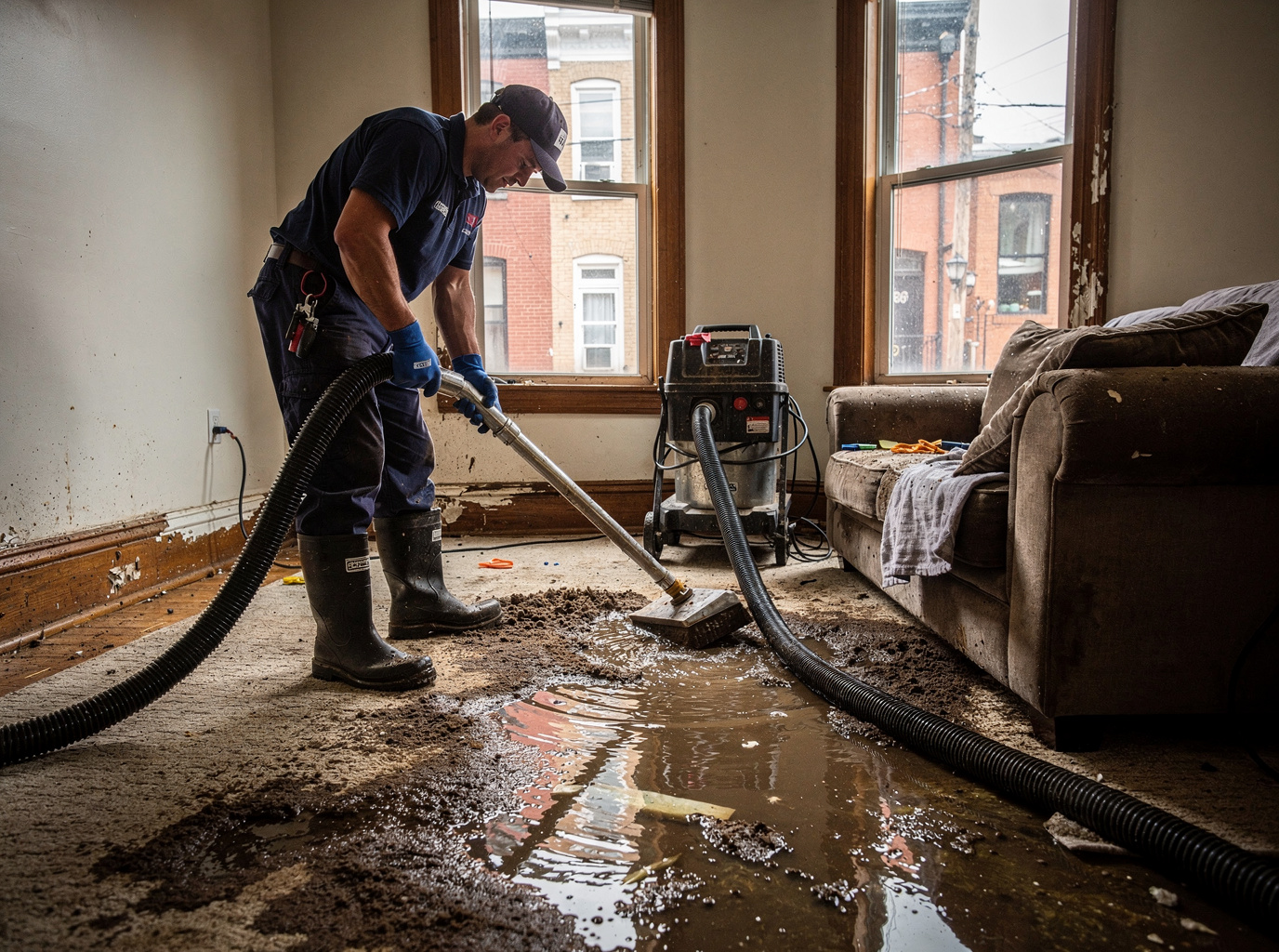
Philadelphia's dense stock of pre-war row homes in neighborhoods like Fishtown, Kensington and Northern Liberties often features shared brick walls and below-grade basements that channel storm runoff quickly during the region's humid subtropical summers. When heavy rains hit, water enters through old mortar joints and cracked foundations faster than in newer suburban builds, requiring immediate extraction to prevent saturation of lath-and-plaster walls. Technicians must work around narrow stairwells and limited access points that are common in these blocks.
Cold winters bring pipe bursts in unheated spaces of West Philadelphia and Germantown homes, where water spreads across concrete slabs and into neighboring units before anyone notices. Extraction crews use submersible pumps and moisture meters to map hidden pockets behind cabinets and under finished flooring, because residual moisture in the area's clay-heavy soils can wick back into walls days later. This local pattern demands thorough removal before drying equipment is placed.
Properties near the Schuylkill and Delaware river corridors, including parts of University City and Manayunk, see occasional tidal or sewer backup events that mix with street debris. Extraction here includes separating clean and contaminated water streams to protect adjacent units in tightly packed blocks. Crews coordinate with local drainage realities rather than treating every job as a simple spill.
Technician insight
In Philadelphia the thing that catches most people out with Water Extraction Services is how quickly water travels through the clay soil and old brick foundations in neighborhoods like Manayunk and Roxborough during a winter pipe burst. Narrow basements and shared walls mean you have to map every direction before you start pumping or the job doubles in size overnight.
South Philadelphia Row Home After Summer Storm
Water entered a finished basement through a window well during a July thunderstorm. Extraction revealed water had wicked under the carpet and into the shared wall with the next house. Crews removed the standing water and saturated padding the same afternoon, then verified moisture levels on both sides of the party wall before leaving drying equipment in place.
Water Extraction Services Services We Offer
✓Basement Water Extraction
Removes standing water from below-grade spaces common in Philadelphia row homes before it reaches joists or shared walls.
✓Storm Water Removal
Handles rainwater that enters through windows, doors or foundations after summer thunderstorms in South Philadelphia and Center City.
✓Carpet and Rug Extraction
Pulls water from wall-to-wall carpet and area rugs in older homes where padding traps moisture against hardwood subfloors.
✓Appliance Leak Extraction
Extracts water from washing machine, water heater or refrigerator leaks that pool on concrete slabs in Kensington and Roxborough basements.
✓Sewage Water Extraction
Removes contaminated water from backups that affect properties near older municipal lines in North Philadelphia and Germantown.
Water Extraction Services Cost in Philadelphia, PA
| Service | Typical Range | What Affects It |
|---|---|---|
| Small room or closet extraction | $250–$450 | Depends on depth and whether carpet removal is needed. |
| Full basement extraction | $600–$1,200 | Higher when water reaches multiple rooms or shared walls. |
| Appliance leak cleanup | $200–$400 | Lower when limited to hard surfaces. |
| Sewage-contaminated extraction | $800–$1,500 | Includes extra containment and disposal steps. |
Ranges are typical for Philadelphia, PA and confirmed with an exact written quote before any work starts.
How it works
- 1
On-Site Assessment
Technician inspects the source, measures water depth and identifies affected materials while noting shared-wall risks in Philadelphia row homes.
- 2
Water Containment
Barriers and pumps isolate the affected area to prevent migration into neighboring units common in Fishtown and Northern Liberties.
- 3
Extraction
Submersible pumps and wands remove standing water from floors, carpets and cavities before moisture reaches lath or insulation.
- 4
Post-Extraction Check
Moisture readings confirm removal across concrete, wood and drywall so drying can begin without hidden pockets left behind.
Pricing
Prices vary by water volume, access difficulty in older row homes and whether contamination is present.